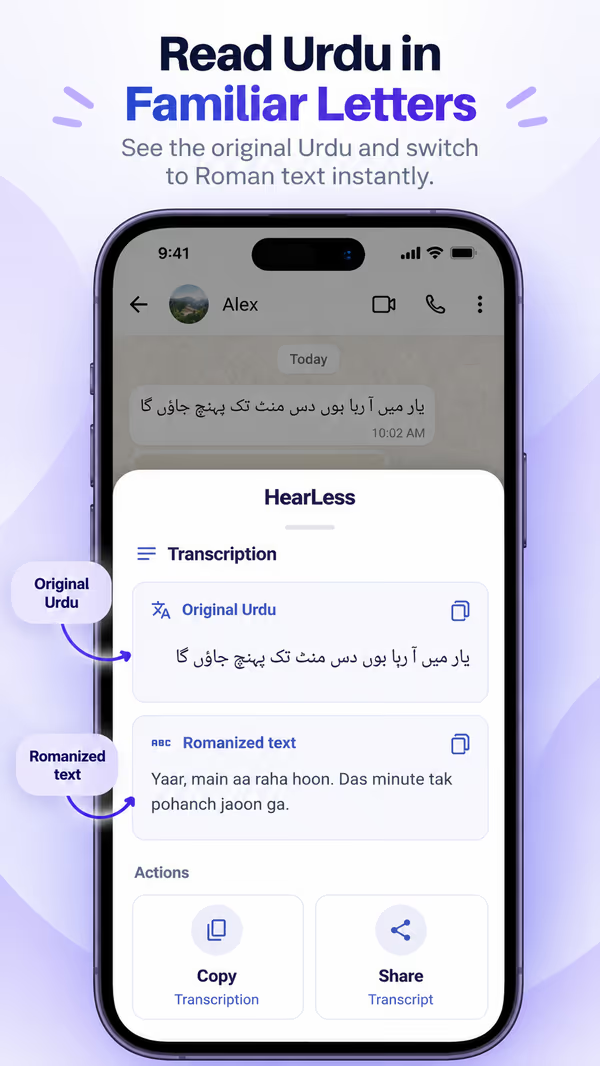
Roman Urdu is Urdu written with Latin letters, the alphabet used for English, instead of Urdu script. For example, “Urdu mein likha hua” is Roman Urdu. The language is still Urdu; writing it with a different alphabet does not translate it into English.
This guide explains the meaning, shows the same phrase in both scripts, and separates Roman Urdu from English translation and mixed-language writing.
What is Roman Urdu language?
Roman Urdu is a way of writing Urdu, rather than a separate spoken language. People often use it in messages when a Latin keyboard or Latin letters are easier for them to use.
An example in Urdu script and Roman Urdu
| Urdu script | Roman Urdu |
|---|---|
| اردو میں لکھا ہوا | Urdu mein likha hua |
The example uses the same Urdu words in two writing systems. Roman Urdu spelling varies: there is no single spelling system used by everyone in everyday chats.
Is Roman Urdu an English translation?
No. Transliteration changes the writing system; translation changes the language. A Roman Urdu message is still read as Urdu, even though its letters also appear in English.
That distinction matters when choosing an audio-to-text tool. Ask for Roman Urdu when you want Urdu words in Latin letters. Ask for an English translation when you want the meaning expressed in English. Hearless’s Roman-script option is for the former; it is not a promise of English translation.
Why do people prefer it?
A few honest reasons:
- Keyboards. Most phones default to a Latin keyboard. Typing Nastaliq means switching keyboards and hunting for letters.
- Reading speed. Plenty of people speak Urdu fluently but, having studied in English-medium schools, read Latin letters faster than Nastaliq.
- Code-switching. Everyday Urdu is full of English words — “meeting,” “office,” “WhatsApp.” Roman Urdu lets both sit on the same line without switching scripts.
Other languages can also be written in Latin letters. Hinglish, however, generally refers to mixing Hindi and English; it is not simply another name for Roman Urdu.
Where voice notes come in
If you receive a spoken Urdu voice note and prefer reading Latin letters, look for transcription with a Roman-script output option. Check the languages offered in your own WhatsApp settings before choosing a separate app; availability can change by platform and version.
Hearless transcribes an Urdu voice note and returns it in Roman script, close to how you’d type it yourself — with a one-tap switch back to Nastaliq. It handles the Urdu-English mix, too.
The short version
Roman Urdu isn’t “lazy” or “wrong” — it’s a practical writing system that fits how people actually use their phones. And now your voice notes can arrive in it too.
Next: how to turn an Urdu voice note into text, step by step.